Transmission Shop Near The Orleans Hotel & Casino

A transmission shop near The Orleans Hotel & Casino puts you on the west side of the valley, close to Flamingo Road and Orleans Arena — handy if you don't want to drive across town for a repair. But distance isn't the real question. The real question is which shop you can trust with a problem you can't see and can't easily check yourself.
That worry is normal. A transmission repair is expensive, the cause isn't obvious from the dashboard, and most drivers have no way to verify whether a quote or a diagnosis is honest.
This guide covers what separates a shop worth trusting from one that's just convenient, what makes a transmission reliable in the first place, and whether a used transmission is ever the right call.
Key Takeaways
- Industry certification, like ATRA membership, and a BBB rating tell you more about a shop than star counts alone.
- Ask for a written diagnosis, explained in plain English, before you agree to any rebuild.
- A used transmission swapped in without diagnostic work can fail for the exact same reason the original one did; see how a rebuild compares to a replacement before you decide.
- Warranty terms should be stated in miles and months, not just the word “warranty.”
- Rideshare and fleet drivers should ask about turnaround time up front, since downtime costs money every day the car sits.
Table of Contents
Which transmission shop in Las Vegas is considered the best?
The best shop is the one that explains the diagnosis in plain language, backs the work with a written warranty, and has enough years in business to have seen your exact failure before. None of that shows up in a star rating. A shop can rack up five-star reviews and still rush a diagnosis, quote a rebuild for what was actually a bad sensor, or drop in parts that don't match your application.
What should you check before trusting a shop with your transmission?
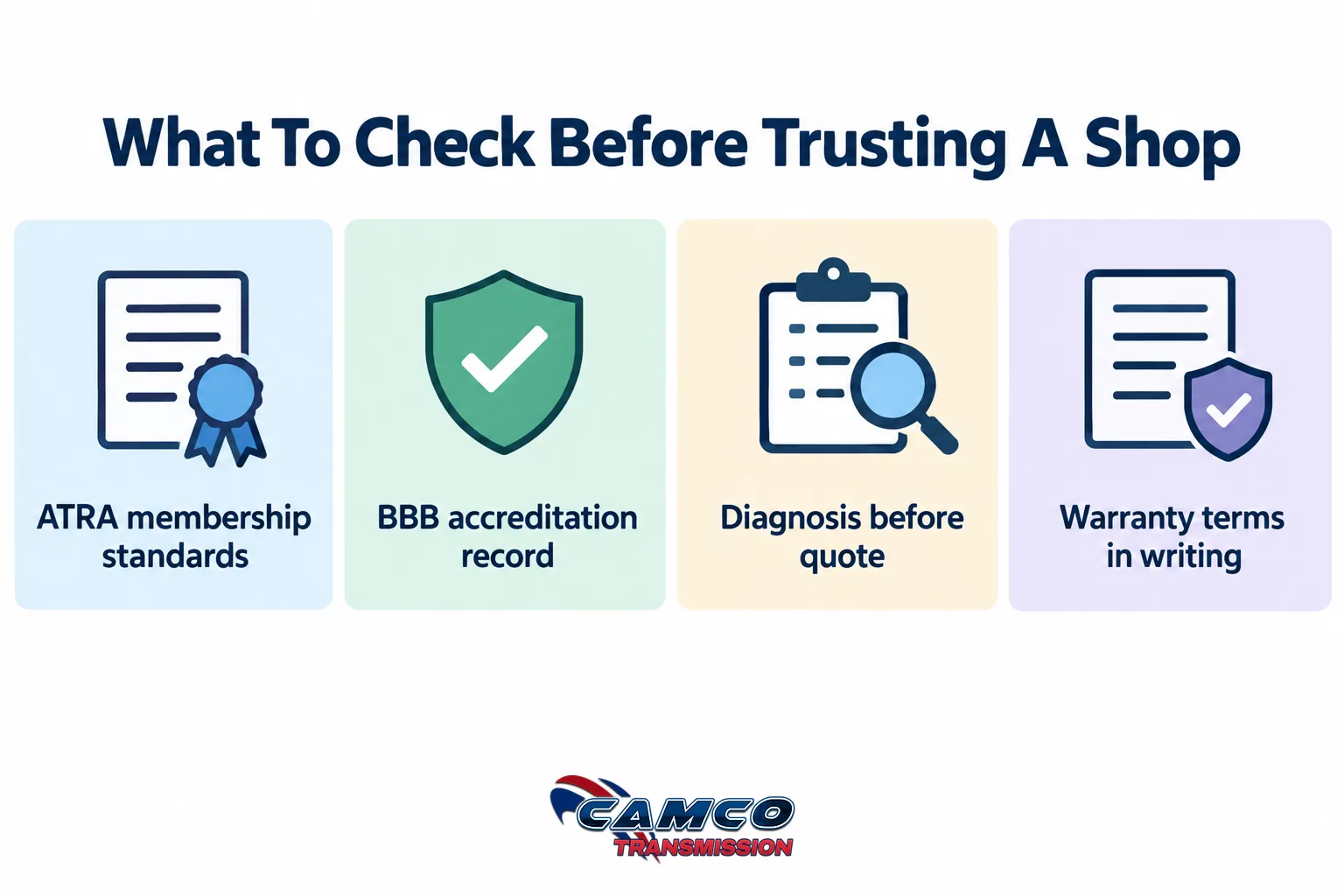
Start with membership in the Automatic Transmission Rebuilders Association (ATRA) — it sets standards for rebuild quality among member shops. Check for Better Business Bureau accreditation too; that reflects how a shop handles complaints over years, not just this week's reviews. And make sure the diagnosis comes before the quote, not after. Get warranty terms in writing — miles and months, not a verbal promise.
What company makes the most reliable transmissions?
No automaker builds a transmission that never fails. Reliability has more to do with maintenance history and heat exposure than the badge on the hood. Foreign and domestic units both run on fluid that breaks down under stress, seals that harden with age, and bands and clutches that wear with mileage. A transmission with clean fluid and regular service will outlast one from a “reliable” brand that's never been checked.
Does the brand of your transmission affect who should rebuild it?
It affects the parts and the process, not whether the shop is capable. A shop that handles both foreign and domestic vehicles should pull the correct specs, torque values, and fluid type for your exact transmission. If a shop only works one brand or platform, ask straight out whether they've rebuilt your model before. A proper diagnosis — the kind covered on this page on transmission diagnostics — should find the real failure point no matter what badge is on your car.
Is a used transmission a good idea?
A used transmission can save money upfront, but it carries real risk — you usually don't know why the original one was pulled. It might have 80,000 miles of hard use left in it. Or it might carry the same internal wear that's about to take yours out. No inspection history rides along with it either way.
What's the difference between a used, remanufactured, and rebuilt transmission?
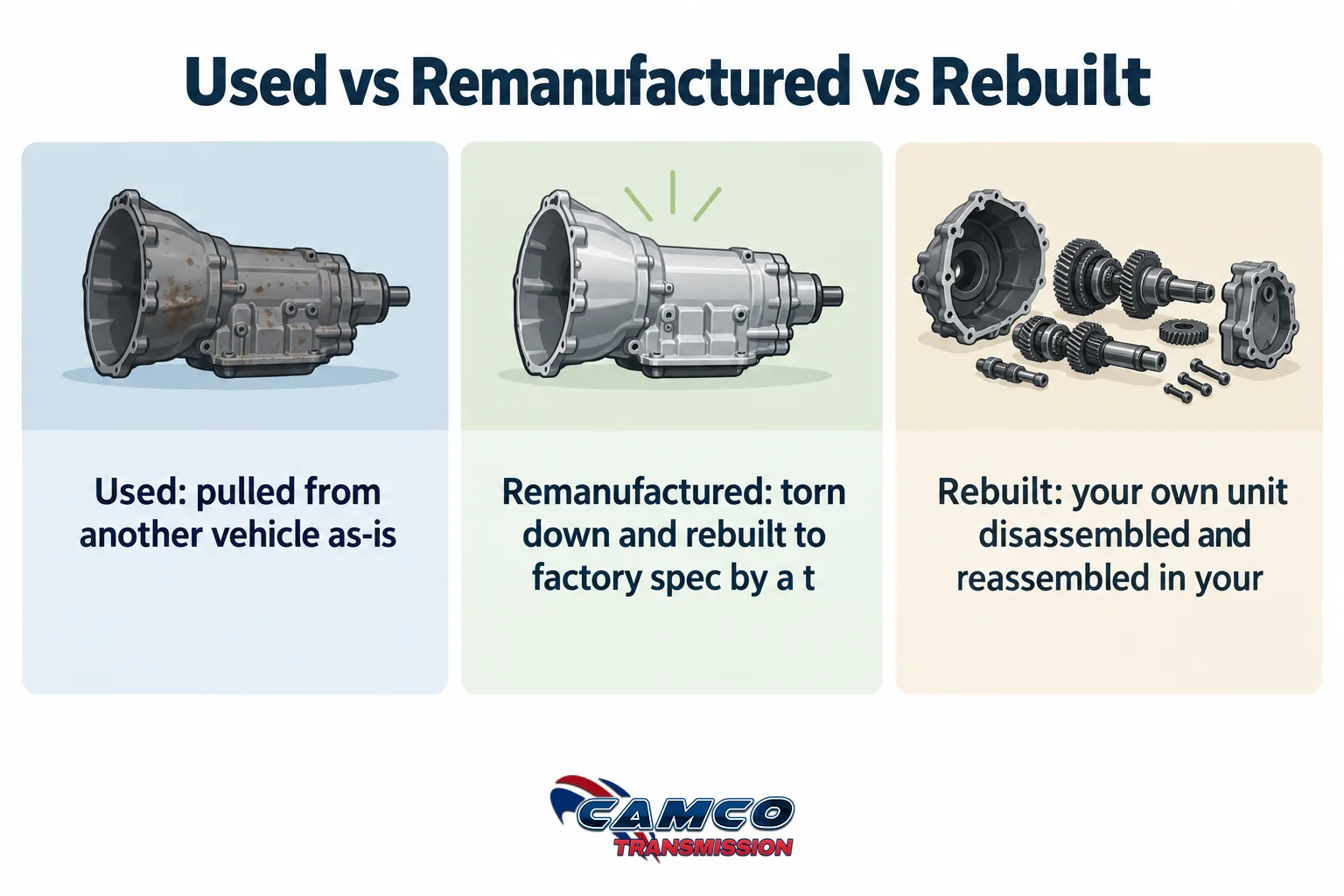
A used transmission comes out of another vehicle as-is — no guarantee of condition. A remanufactured transmission gets torn down and rebuilt to factory spec by a third party, usually with some warranty attached. A rebuilt transmission is different: your actual unit is disassembled, worn parts get replaced, and it's reassembled and tested in your car. That's the only option where the shop controls every part going back in. Compare the cost and outcome of each path on the transmission rebuild page.
- Get a written diagnosis first. Don't agree to any transmission work until you have a plain-English explanation of what's actually failing.
- Ask about warranty terms specifically. Get the mileage and time period in writing, not just the word “covered.”
- Compare rebuild vs. used vs. remanufactured. Ask the shop to explain why they're recommending one option over the others for your situation.
- Confirm turnaround time. If you drive for work or run a fleet, ask how long the car will be out of service before you commit.
Find a Transmission Shop Near The Orleans You Can Trust
CAMCO Transmission sits just east of The Orleans Hotel & Casino on Wynn Road, close to Orleans Arena. It carries BBB A+ accreditation and ATRA membership, backed by more than 20 years diagnosing and rebuilding transmissions for foreign and domestic vehicles.

Full rebuilds come with a 12,000-mile, one-year warranty, and a 24,000-mile, two-year upgrade is available if you plan to keep the car a while. CAMCO also handles transmission diagnostics, engine repair, tune-ups, brake service, and fleet maintenance — one visit can cover more than just the transmission.
If something feels off when you shift, get it checked before it gets worse — start with an honest diagnosis on the transmission repair page.
Frequently Asked Questions
Who is the best transmission repair shop?
The best shop has verifiable credentials — ATRA membership, BBB accreditation — and gives you a written diagnosis before quoting a repair. Years of experience with both foreign and domestic transmissions matters too, since failure points differ by make and model.
How do I know if my transmission needs a rebuild or a replacement?
A proper diagnosis shows whether the damage is isolated to a few worn parts — usually a rebuild job — or spread wide enough that a replacement unit makes more sense. A shop should walk you through that reasoning in plain terms before quoting either one.
What warranty should a transmission rebuild include?
Look for a warranty stated in both miles and months — whichever limit you hit first is the one that counts, and that depends on how much you drive. A 12,000-mile, one-year warranty is a common baseline, with longer coverage sometimes available as an upgrade.
How much does a transmission diagnostic cost in Las Vegas?
Diagnostic cost varies by shop and by how much teardown it takes to confirm the problem. Ask for the fee upfront, and ask whether it gets credited toward the repair if you move forward.
Can I still drive if my transmission is slipping?
Driving on a slipping transmission risks turning a repairable problem into a full rebuild — slipping means internal parts are already wearing under load. Get it looked at as soon as you notice delayed engagement, RPM flare, or gear hunting.
More articles
- Signs of a Bad Transmission Solenoid
- Transmission Noise When Accelerating: Whining, Humming or Grinding
- Truck and Van Transmission Repair in Las Vegas
- Transmission Repair Near the Las Vegas Strip for Locals and Workers
- Torque Converter Problems: Signs, Causes and Repair Options
- Car Shifting Hard? What Hard Shifts Mean for Your Transmission